My Blog List

Thursday, 28 February 2019

Award for wildflower seedball matchboxes


A range of matchboxes containing wildflower seeds has been voted this year’s best new product at the Garden Press Event in London. Receiving the award were Dr Emily Lambert, co-founder of the company, Seedball, and Operations Manager Mika Underwood (left).
A tiny product, but a great idea. Inside each box are six seedballs, each a mini eco-system, containing about a hundred seeds (chosen to encourage bees and butterflies), peat-free compost, nutrients and minerals, all protected by an outer coating of clay. No fiddly planting or germination is needed – just scatter the 1cm balls on the ground, or in a pot or windowbox, and watch for the blooms to appear. Mika says as well as being a perfect little gift, the boxes can also be personalised for a wedding or party favour (below).
From £1.80. Stockists include Kew, the National Trust, Highgrove and Notcutts, Clifton Squires and Petersham nurseries.


Friday, 8 February 2019

The Dollis trail: Brent Cross to Woodside Park


It was a grey, damp February morning when we set off from Brent Cross in north London to follow the Dollis Valley Greenwalk as far as Woodside Park. It had been raining the night before – the paths were muddy and the stream was in full spate, carrying fallen branches and debris downstream.
But everywhere were early signs of spring. Crocuses were pushing their way up through the carpet of leaves and nestled under the trees some tiny double snowdrops had emerged.
Birds were out too, paddling through the water in search of food.
We even spotted an egret.
The Greenwalk runs for about ten miles through much of the valley, linking areas of countryside and public spaces. It’s now surrounded by London suburbs, but you can still get glimpses of what the area was once like. The Abbots of Westminster had property there by 1284 AD, and the Decoy Ponds, at the north end of Brent Park, are thought to be remnants of a lake created by them as a duck decoy.
In the 18th century a stuccoed mansion, Brent Bridge House, later the seat of the Whishaw family, was built just north of the stream next to Decoy Wood, and some of it survived as part of the Brent Bridge Hotel. By the bridge are two picturesque but rather dilapidated pavilions that may have heralded the entrance to the property.
An Ordnance Survey map of 1900 shows both the mansion and, on the south side of the stream, Brook Lodge, once a farmhouse but converted to a gentleman’s residence by Charles Whishaw shortly before 1828. It was demolished in 1935, after serving as an annex to the hotel.
Following the Dollis (now a brook) north, we came to the 13-arched viaduct that soars up 60 feet above Dollis Rd and is the highest point on the London Underground system. It was built in 1863 as part of the Edgware, Highgate and London Railway and originally provided a link to the rail network for steam trains. A triumph of Victorian engineering, it is still in service, now carrying Underground trains on the Northern Line to Mill Hill East.
Windsor Park is also part of the Greenwalk. There we found a memorial stone to Flying Officer Kenneth Charles Legge, of 571 Squadron. A former resident of Village Rd, Finchley, he took off from RAF Oakington in Cambridgeshire on Feb 6 1945, piloting a Mosquito plane on a bombing mission to Berlin. But that was the last time he was seen – he and his plane vanished without trace.
The memorial was erected by his mother, Mary Elizabeth Legge. A Google search reveals that it was a second tragedy for the family - Kenneth Legge’s wife, Ruby, had been among the hundreds killed in a devastating bombing raid on Manchester on December 23, 1940.
To the north of Windsor Park, still following the Dollis, are the Fursby Avenue allotments. It was encouraging to see evidence of dedicated gardeners having being hard at work, despite the weather, and at least one walker in our group left determined to go home and get to work in the garden, repairing some of the winter's ravages.

Wednesday, 28 November 2018

An Autumn Odyssey to Savill Garden


As leaves began turning to fiery reds, oranges and yellows, members of our garden club had a group visit to the Savill Garden at Egham in Surrey. Created by Sir Eric Savill in the 1930s out of a corner of Windsor Great Park (once William the Conqueror’s hunting ground), it has 35 acres of interconnected gardens, designed to provide colour and interest all year round.
Our first glimpse of what was on offer was the still-flowering meadow of pink and white cosmos outside the impressive visitor centre, opened in 2006 by the Duke of Edinburgh. The building blends beautifully into the landscape; timber for the floor and swooping roof came from the Windsor Estate. It houses restaurants and gift shops, and we returned there later for a hot lunch and a relaxed browse around the garden-related products. Eric Savill (1895 – 1980) was the grandson of Alfred Savill, the founder of a large firm of estate agents. After taking over the management of Windsor Great Park in 1930, with the encouragement of George VI and Queen Elizabeth, the Queen Mother, he began turning part of the woodland into a place to be enjoyed by everyone, from dedicated horticulturists to families.
The Savill Garden opened to the public in 1951, and over the years it has grown and evolved. We began our walk by one of the lakes, where gunnera leaves had been upended to create shelters for the crowns of plants beneath. With us was one of the centre's very knowledgeable guides, who answered our many questions and pointed out some of the garden's highlights, including the extensive hydrangea collection.
Among the many royal associations is The Queen Elizabeth Temperate House, opened in 1995. It houses a wide variety of tree ferns, but when we were there, pride of place was being given to a display of prize-winning squashes - at over 600 lbs each, rather too big to fit in an oven.
In the Golden Jubilee Garden (2002) was another surprise - a clematis, Madame Edouard Andre, still flowering prolifically.
A further splash of colour came from this bed of dahlias.
It's obvious that much thought has gone into the planting and the juxtaposition of different varieties  and textures. I loved the stripes of colour lining this path, the black grasses adding a touch of drama.
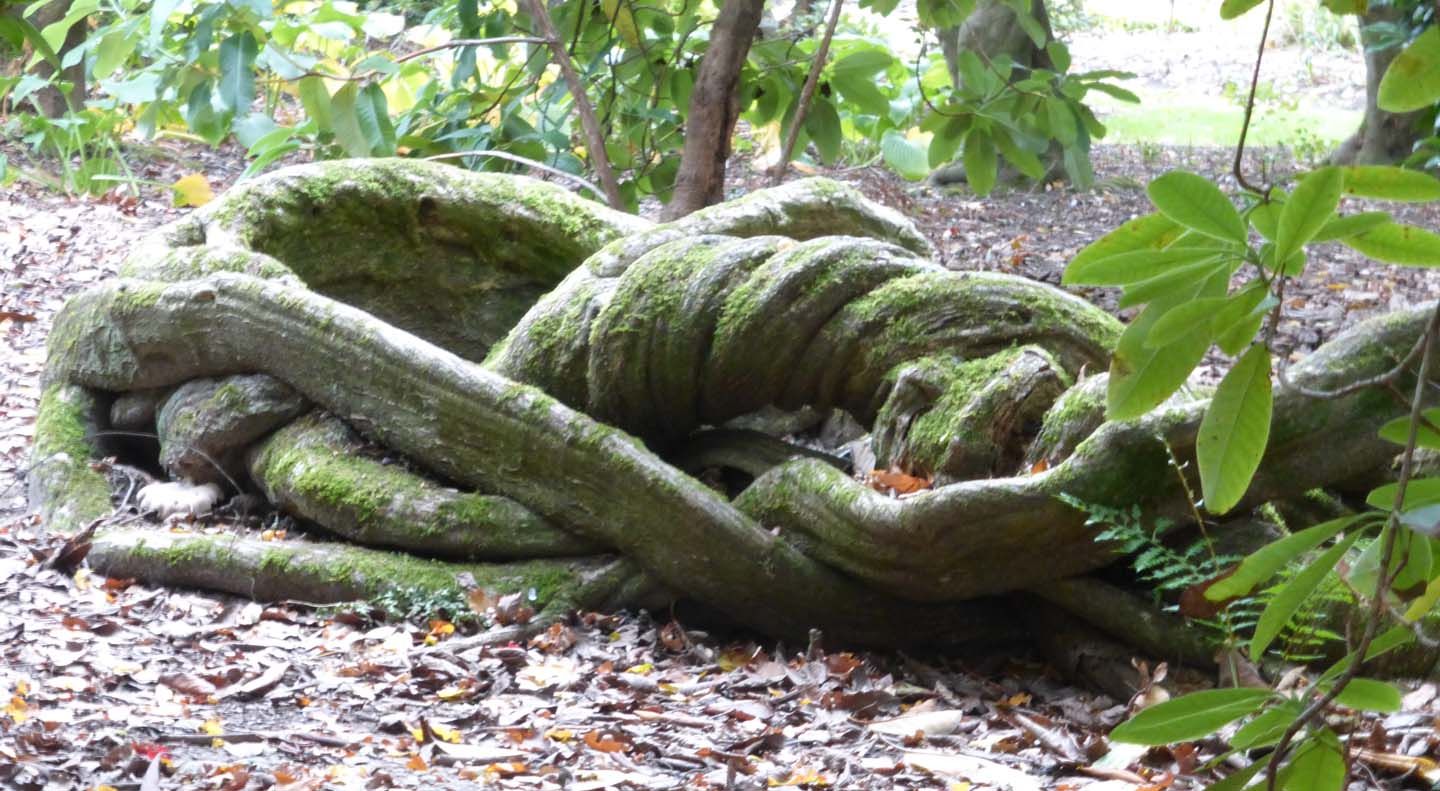
While some of the planting is new, there are also some ancient trees. One of them was almost engulfed by a giant wisteria with tangled and twisted roots that made it look like a jungle escapee.
We were too late in the year to see the best of the new contemporary Rose Garden, opened by the Queen in 2010, and obviously missed the rhododendrons and magnolias in the Spring Wood. However, plans are afoot for a further visit next year.
Savill Garden, Wick Lane, Egham, Surrey. TW20 0UJ. Individual entrance fee £5 (includes parking). Opening hours vary with the seasons.

Tuesday, 16 October 2018

Surprises along the River Brent


A meander along the River Brent in west London on a rather overcast autumn day took us from Hanwell to Perivale – and revealed some unexpected sights. The first, on leaving Hanwell station, was the towering edifice of the  Wharncliffe Viaduct. Designed by Isambard Kingdom Brunel and built in 1837, it was used by the Great Western Railway to carry the trains from London to Bristol across the Brent Valley.
The huge semi-elliptical arches each span 21 metres.The two endmost are actually hollow, and home to what is thought to be London’s largest colony of Pipistrelle and Daubenton’s bats. The viaduct also carried the world’s first commercial electrical telegraph, which came into use on April 9, 1839. This gained much publicity when it was used to alert the police in London that a murder suspect in Slough had caught the train, leading to the first arrest due to electric communications.
The Brent flows beside the viaduct for some distance. Nearby is an area of woodland, Hobbayne Half Acre Field. This is part of land gifted by a Hanwell yeoman in 1484 to be used for the poor and needy of the parish. Since then, the Charity of William Hobbayne has been making a difference to the local community; in 2016 a partnership was formed between it and Trees for Cities, a charity working to green cities and plant trees worldwide.
Now a range of waterside habitats have been installed along the Brent in the hope of increasing the numbers of water voles in the area. These were once widespread, but their numbers have declined over the past century because of water pollution and loss of habitat. Kingfishers and herons have also been spotted by the river - we were lucky enough to spot this one.
Looking to the north you can catch a glimpse of the spire of the parish church of St Mary’s, Hanwell. Built in 1841, it’s one of the very early churches designed by George Gilbert Scott (later the architect of the Albert Memorial). The park that leads up to it, Churchfields, was once agricultural land that belonged to the church. In 1902 it became a formal park, and today has avenues of trees, a children’s playground and tennis courts. A colourful touch was this river of flowers that weaves its way through the wide expanse of grass.
Another highlight was in Brent Lodge Park - the Millennium Maze. It was created on the site of an old bowling green, using 2000 young yews, and demonstrates just how slowly these trees grow. At the moment only the smallest child would have trouble finding a way through, so it has a long way to go before it rivals the famous one at Hampton Court.
We followed the Brent through some quite dense woodland, spotting dog walkers, golf enthusiasts heading for the local club, and some ducks having a rest while dabbling their feet in the  river.
After a short cut along the Western Avenue, we reached our final destination, St Mary’s Perivale, a tiny, beautiful 12th or 13th  century church that, separated from its parish by the development and heavy traffic on the A40, became redundant in 1972. It was rescued from dereliction by the Friends of St Mary’s Perivale and transformed into an exceptional music venue serving west London.
The church itself is unusual, with a tower clad in white weatherboarding. It’s normally closed, but we arrived as preparations were being made for one of the regular Tuesday lunchtime concerts. These are free, with a retiring collection, and no tickets are issued, so you can just turn up.
A quick peep inside revealed a Tudor font and memorial stones and brasses to distinguished former residents, many of whom had lost their lives in farflung parts of what was the British Empire. Among the many graves in the churchyard is that of Elizabeth Colleton, who died in 1721. Although it’s known as the Maiden’s Tomb, she was in fact the widow of a Cornish baronet and subsequently the mistress of Richard Savage, the Earl Rivers. He left his fortune to her, rather than his wife and daughter. She (or in another version of the legend, her father) is reputed to have said that, if there was a just God, trees would grow out of her tomb, and this is what actually happened. By the late 1800s these had caused the chest tomb to collapse, but it was rebuilt in 1999 by architect Adrian Cave.
Today, the space around it has been cleared (above) and the detailed carving on the tomb is revealed once more. It's a peaceful spot, a world away from the A40 with its never-ceasisng stream of traffic, and Perivale Tube on the Central line,  just a few minutes to the north. Well worth a visit..