My Blog List

Monday, 16 January 2017

Walking the Lea Valley 5: Tottenham Hale to Ponders End


A walk along the Lea Valley offers many glimpses of the area’s industrial past. But I was unprepared for the sight of two traditional powder barges, the Renaissance and the Judith, moored at Hale Wharf. They floated there, brown sails furled, looking as if they’d just unloaded a cargo of gunpowder and were awaiting further instructions. But I later discovered that not was all as it seemed. The two barges are reproductions, based on the design of the last of these sailing barges, the Lady of the Lea, built in 1931. They were commissioned by British Waterways as part of an ongoing regeneration plan for the area. And while their exteriors are traditional, below decks they apparently offer modern commercial space for anyone who fancies a memorable home for a business.
Regeneration is the buzz word along the Lea - the barges will soon be surrounded by up to 500 new homes. We saw more evidence of this when we started our walk at Tottenham Hale. Almost the first building we came across was this colourful apartment block, on a site where once stood the Gestetner duplication machine factory, opened in 1906 and until the 1970s employing around 6000 people.
The Lea at this point runs alongside a series of reservoirs, which provide 10% of London’s water. They’re surrounded by high banks where sheep graze peacefully.

Despite the icy January weather, there were plenty of birds about, perhaps hoping for scraps from the few canal boats that were still occupied.

This heron, sheltering among the bushes, had its plumage fluffed up to keep warm.

Further along was a flock of geese.


We paused at Pickett’s Lock, named after some early inhabitants, the Picot or Pickett family, who were descended from one Picot de Marisco (of the marsh), who lived locally in the 13th century. In 2015 it was temporarily renamed Alfie’s Lock in honour of former lock keeper Alfie Saggs. The new name is still in evidence and a sign outside the lock-keeper’s cottage reads Alf Saggs, Best Man on the Lea.


Further along, an information sign told us the river is so healthy these days that otters live there. Well, we did keep our eyes open, but they probably saw us first.

We passed the Lee Valley Athletics Centre, opened in 2007, and could just make out some hardy souls enjoying a round of golf on the neighbouring course.
 Our walk ended with a  very welcome lunch at the Harvester, housed in what started life back in 1899 as the Ponders End pumping station. The name, Ponders End, is another one that goes back a long way. A John Ponder is mentioned in a decument of 1372 and the surname is believed to mean a keeper of, or dweller by, a fish-pond or mill-pond. There’s been a mill here since at least the late 16th century and possibly as far back as the time of the Domesday Book (1086). The mill came under the control of George Reynolds Wright in 1870 and today Wright’s Flour Mill is Enfield’s oldest working industrial building.

Our final stop was by the entrance to the mill, to admire this charming Georgian lodge which may once have housed the miller.Lovely to see it still seems to be lived in.

Wednesday, 14 December 2016

Walking the Lea Valley 4: Graffiti, grebes – and a Victorian scandal


The area around Hackney Wick station, where our latest ramble began, has perhaps the highest concentration of graffiti and street art in London. Everywhere you look, the buildings are covered with brightly coloured paint.
Even the derelict Lord Napier pub has not escaped. Some decorations are crude, some are fun and many are beautifully executed. They are constantly changing, and have become such a landmark that websites are devoted to them.
It’s all very gritty and urban, but turn a corner, and the green spaces of the Olympic Park and the Lea Valley come into view.
The towpath is home to many new developments, but street art does continue.
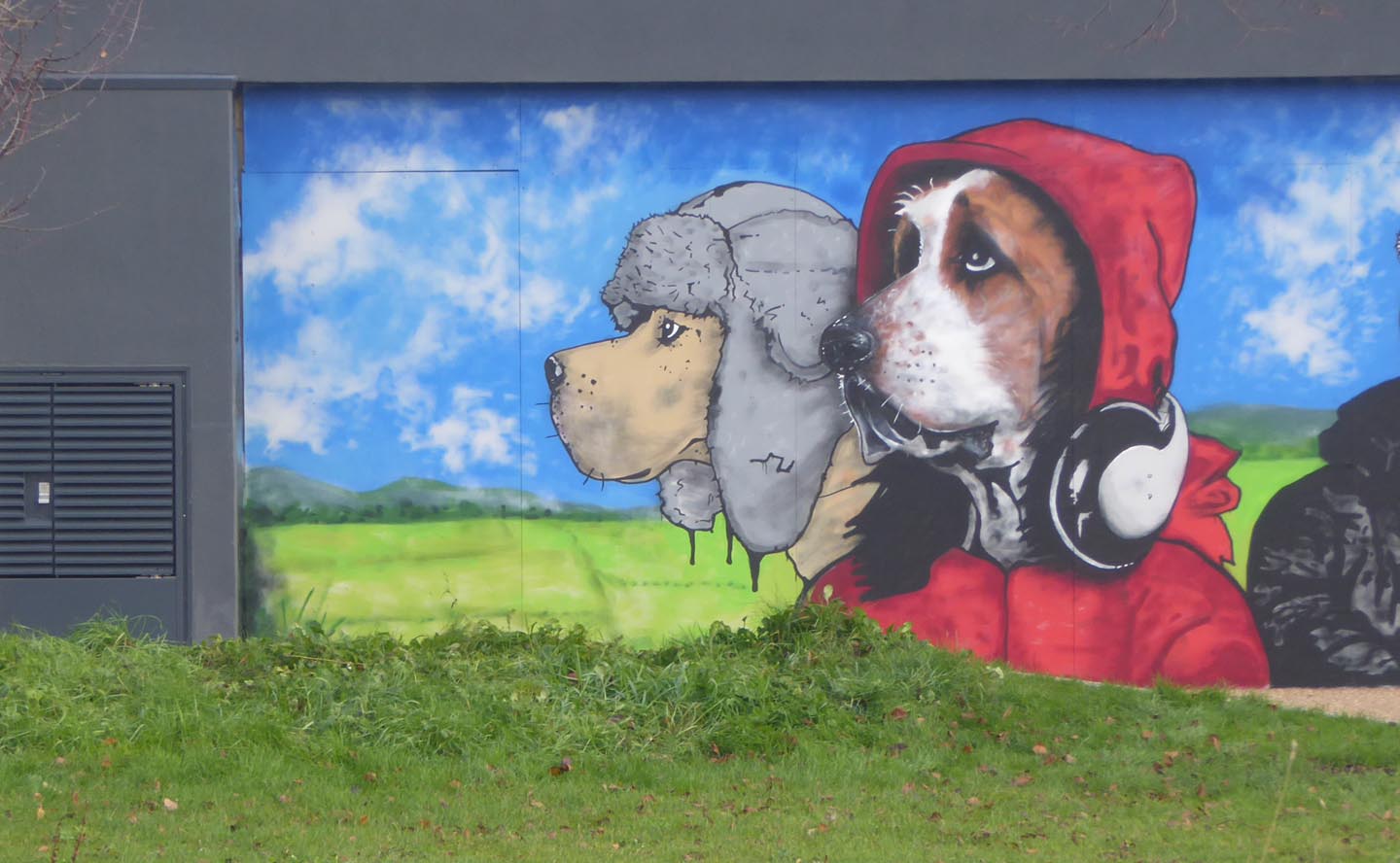
We saw one artist hard at work, beside a huge mural of some soulful-looking dogs.
This stretch of the river is home to dozens of canal boats, and is overlooked by a new apartment block that has been built on the site of the former Lesney Matchbox toy factory.
This was founded in 1947 by Leslie and Rodney Smith (not related) and in 1966 employed more than three and a half thousand people, many being bussed in by a dedicated fleet of vehicles. Sadly, by 1982 demand for the tiny toys had slackened and the company went into receivership. The Matchbox name was sold and the factory demolished, but Lesney is commemorated in the name of the new building.
The next stretch of water took us past the wide open spaces of Hackney Marshes, extensively drained in medieval times and now filled in with rubble – much of it from buildings destroyed during WWII. These were once Lammas lands, cultivated by their owners from April 6 to August 12, and available for commoners to graze cattle for the rest of the year. Today, the 336 acres, carefully groomed, are  home to more than 80 football, rugby and cricket pitches.
We paused at the Middlesex Filter Beds nature reserve - the relic of an attempt to provide clean water after a major cholera epidemic in the mid 1800s. Closed in 1969, it's now a thriving mixture of open water, reed beds and wet woodland habitats. At the centre of the reserve a child was playing in what looked like a prehistoric henge, but is actually a sculpture by Paula Haughney -  Nature’s Throne - made from huge granite blocks salvaged from an old engine house.
The reserve is said to be home to more than 200 plant species, and some 60 types of birds. Not many of these were in evidence on this grey December day, but we did spot some grebes (above), and later saw a cormorant drying its feathers.
Further along the river there was a heart-stopping moment when a fox came into view, slinking along the towpath behind some swans. They ignored him, and luckily he went off in search of easier fodder.

Our next stop was by a series of arches that now support the Overground railway.
At first sight, they seem quite unremarkable. But a closer look reveals a plaque that relates how here, under two of them, aviation pioneer Alliott Verdon-Roe assembled his Avro No 1 Triplane, and on July 12 1909 wheeled it out to make the first all-British powered flight. The plane managed just 15 metres but it was a start, and later Avro planes served both World Wars – the Lancaster was used in the Dambusters raid. Verdon-Roe was knighted in 1928, and in 1963 Avro merged with Hawker Siddeley Aircraft.
The final leg of our ramble took us past Springfield Park, from where we could see the spire of the Cathedral Church of the Good Shepherd, which began its life as the Church of the Ark of the Covenant for the Agapemonite (Abode of Love) sect. It was hard to reconcile this peaceful suburban scene with the discovery that this building was linked to a scandal that shocked Victorian society. The sect had been founded in Somerset in the mid 19th c by Henry James Prince, a defrocked Anglican clergyman who claimed the Second Coming was imminent and that he was the visible embodiment of the Holy Spirit. His followers included many wealthy spinsters who were encouraged to hand over their earthly possessions and become ‘spiritual brides’. (He lived in comfort, surrounded by the most attractive of the women, while the others worked in the gardens or on his farm.) Despite his proclivities and numerous scandals (the family of one young follower kidnapped her, then had her declared insane and incarcerated in a lunatic asylum), the sect continued, and in 1892 relocated to Clapton, where Prince commissioned the Gothic Revival-style church we could now see. He surprised his followers by dying in 1899 (they thought he was immortal) and was hastily buried in the front garden in the middle of the night. He was replaced by the Rev John Hugh Smyth-Pigott who recruited some 50 young female followers to supplement the ageing population of Agapemonites, but after his death in 1927, the sect gradually declined. The building was used by the Ancient Catholic Church for a time, and became the Georgian Orthodox Cathedral in 2011. The carvings and stained glass are said to be worth a visit, but sadly we’d run out of time, so had to turn away from the Lea and head to Tottenham Hale and the Tube home.

And there's also a lot more about the Agapemonites on http://www.utopia-britannica.org.uk/pages/abode%20of%20love.htm


Wednesday, 16 November 2016

Waddesdon Manor lights up for Christmas


Until now my visits to Waddesdon Manor, near Aylesbury in Buckinghamshire, have been in the summer. So it was a delightful surprise on a grey November afternoon to discover the house and grounds dressed for Christmas. As dusk fell, the ornate facade was illuminated with a light and sound show, a rainbow of lights keeping time with music from hidden speakers.
Throughout the grounds, trees were lit by spotlights.
Beyond the Aviary was the dramatic installation of Bruce Munro’s Field of Light. Nine thousand glowing glass spheres carpeted the grass, transforming the glade into a magical wonderland that stretches on and on. If you follow the dimly-lit path you can walk right round it, marvelling as the globes wink on and off and change colour. (The route is reasonably flat, but a torch might be useful.)

Indoors, the theme for the decorations is Magical Materials, inspired by the rare and beautiful objects in Waddesdon’s collections.
Even this bathroom had been transformed into an underwater paradise.
Among the more conventional trees was one crafted from exquisite hand-made paper flowers.
More paper flowers adorned these battery-lit candles.

Corridors were transformed as well. One was veiled in white lace, while here, tree decorations continued the Christmas theme..
 Christmas at Waddesdon runs until January 2, with the last entry at 5.30 pm. Traditional Christmas food is served in the restaurant until 6pm, with seasonal snacks in the Wigwam cafe. From November 16 to December 11 there is a Christmas Fair with festive foods from local producers and independent traders, and of course, the Manor shop is open for gifts and souvenirs. For tickets and details see

Sunday, 13 November 2016

Green tomato chutney


What to do with the green tomatoes that remained from a great crop this summer? Inspired by a birthday present of a Kilner preserving set, I’ve turned them and a few remaining apples into some chutney that hopefully will spice up the coming winter months. For the first time, I used a pressure cooker, with a recipe from the internet. It will be a few weeks before the results can be properly appreciated, but a quick sample tasted promising. The recipe specified cooking apples, but as I grow only eating ones, I cut down the amount of sugar used by 40g. The tomatoes weren't skinned - too difficult, even after immersing in boiling water.
.
Green Tomato and Apple Chutney
340g onions
450g cooking apples (weight after peeling)
450g green tomatoes
280 brown or malt vinegar
1/2 tsp salt
1-2 tsp mixed pickling spice
240g sugar (white or brown)
170 - 225g sultanas

1. Peel onions and apples, skin the tomatoes (optional).
2 Chop vegetables and fruit and put in presssure cooker.
3 Add vinegar, salt and pickling spice tied in muslin.
4.Close and bring to H/15lb pressure.
5.Cook for 10 mins.
6.Remove cover, add sugar and dried fruit and stir over low heat until sugar dissolved. Remove bag of spice.
7.Boil in open pan until it turns into a thick puree.
8.Spoon into hot jars and cover.

Friday, 4 November 2016

Walking the Lea Valley 3: Bromley by Bow to Stratford


A red telephone box, cut in two, straddles a path in the Olympic Park by the River Lea. Look carefully and you’ll see an inscription that runs around the glass panes:
   “Before you are spread the arteries of Victorian London. Once busy with boats, by 2005 these were polluted and largely disused. London 2012 unclogged them of 34,144 tonnes of rubbish and brought them back to life.”
And that was really the theme of this month’s Lea Valley walk, although the arteries we discovered were also serving London back in Saxon times. We started at Bromley by Bow on a misty November morning, and once past the roaring traffic on the A102, turned right, and crossed a bridge which spans both the Limehouse Cut and the Lea, running parallel at this point.
Here we entered the picturesque enclave of Three Mills Island. Eight mills were recorded here in the Domesday Survey of 1086. Over the centuries they produced flour for the city’s bread and  gunpowder for the military.gunpowder for the military.

The picturesque Clock Mill (above) dates from 1817. Opposite is the House Mill, said to be the largest tidal mill in the country, and perhaps the world (tours on Sundays from May to October). Peering through the windows we could just see the huge water wheel, driven by high-tide water that was trapped behind a sluice and then released to drive it. 

On the wall is a coat of arms - probably put there by Daniel and Sarah Bisson when they built it in 1776. The third mill, a windmill, survived until 1840. The whole site is now a conservation area with cobbled streets, and home to London’s largest film and television studios. The path then led us round to the new Three Mills Green, the first of a series of planned park spaces that will connect the Olympic Park to the north with the Thames to the south. It’s on the banks of the Three Mills Wall River, where a huge amount of regeneration and redevelopment is going on.
In the distance to the east you can just glimpse the ornate roof of the Abbey Mills Pumping Station (1865 – 8). This Gothic masterpiece was the work of Joseph Bazalgette, chief engineer for the Metropolitan Board of Works, who created a network of sewers under London which was instrumental in relieving the city of cholera and began the cleansing of the Thames. It was designed to lift lower level sewage into the outfall and still operates as a backup for the new pumping station nearby.

We paused at a memorial sculpture with a dedication to four men who “lost their lives in a well beneath this spot on 12 July 1901.” It’s a tragic story of self-sacrifice. A working party had set out to investigate the well, which had been sealed off for ten years. The first to descend, Thomas Picket, was overcome by “foul air” – carbon dioxide –  apparently caused by rotting weeds in the remaining water. The three who successively tried to effect a rescue also succumbed, and by the time the Fire Brigade arrived, it was too late.
 Among those who died was Godfrey Maule Nicholson, Managing Director of the Nicholson Gin Distillery, the then owner of the Three Mills site and part of the famous gin family whose name still adorns many of the pubs around London today. The cross erected to mark the spot was replaced in 2001, the centenary of the tragedy, by the new ‘Helping Hands’ sculpture.We retraced our steps back to the Lea, and walked along the towpath, under the A11.
Just past here the Lea is joined by the Bow Back River – now overlooked by shiny new high-rise developments.
Here there’s a glimpse of the former Bryant and May match factory, the scene of the London matchgirls strike of 1888, prompted by the terrible working conditions. This led to the first British trade union for women. The red-brick building is now a gated community, the Bow Quarter. 
Now the river is clear of rubbish and pollutants, a number of birds have made it their home, among them this coot, poised above its watery reflection. Quite a few canal boats are moored here, some decorated...
...others more obviously working vessels.
They have to pass through Old Ford Lock, first built in 1769 and upgraded and improved in succeeding years. 
Old Ford was the site of a Roman crossing. It’s likely this was a bridge - forty timber piles were found in excavations at Dace Rd, close to the famous Formans smoked salmon headquarters and restaurant on the western river bank.
There’s another bit of history here: the company was founded more than 100 years ago by Harry Forman, who arrived in London from Russia and used his skill in smoking fish to start a family business, producing what is arguably the finest smoked salmon in the country, the London Cure. The factory was previously on the opposite side of the Lea, but had to relocate, along with 283 other businesses, when the site was chosen to house the 2012 Olympics. The new factory (above) dates from 2009 – its shape resembles a darne of salmon.
There’s quite a lot of imaginative graffiti along this stretch of the Lea, which now splits again into the river and the Lea Navigation, which here becomes the Hackney Cut. We followed the latter around the outskirts of the Olympic Park and caught a glimpse of the Hertford Union Canal (below), branching off to the west.
Lunch was in one of the many riverside restaurants, after which we headed south-east through the Queen Elizabeth Park to Stratford City and a train home. Leafy paths criss-cross the area, one of which took us past the deconstructed phone box (top) and its paean to the transformation of the area.
Nearby was  another example of what has been achieved – a rare ‘wet woodland’ on a former industrial site (above). By creating hollows and channels to encourage the land to become boggy and wet and planting black poplars and alders, it’s become a haven for plants and wildlife. There are fish, insects, kingfishers, goldfinches – and even perhaps, one day, otters. We'll have to return for them.