My Blog List

Tuesday, 29 April 2014

London's changing skyline


There’s an explosion in the number of tall buildings in London.  You may not be so aware of them at ground level, but looking across to the City from the dome of St Pauls the other day - a climb of 528 steps - the change was very evident. And these buildings are just the start - more than 230 towers of over 20 storeys across the capital are in the pipeline. An exhibition at the New London Architecture centre (until 12.6.2014 at the Building Centre, Store St, London WC1E 7BTL) looks at their impact and the planning system.
When St Paul’s was built after the Great Fire of 1666 it was the tallest building in London. At the height of the Blitz in 1940, it still towered over the city and Herbert Mason’s iconic photo of the dome emerging from the surrounding fires and smoke became an image of survival. Ten sight lines to St Paul’s from around the capital enjoy legal protection. With such development afoot, how much longer can these last?

Sunday, 30 March 2014

Inspiration at the Edible Garden Show


There were some interesting exhibits at the 2014 Edible Garden Show, held for the first time at Alexandra Palace in London,  but what really caught my eye was the Wiltshire Wildlife Trust’s Food Champions show garden.  Its focal point was this unusual greenhouse, made from 1500 plastic bottles. They’d been collected by local school children, washed, and with the bottoms cut off, threaded on vertical canes to make walls. A great way to give protection to tender plants, which could be adapted for small-scale projects.
The Food Champions is a 3-year venture which aims to get local communities growing their own food. Last year the organisers gave away more than 700 fruit trees, planted community gardens and taught local people how to grow and cook fruit and vegetables. This year their focus will be on the growing number of military families in Wiltshire, using food to help them become part of their local community. Here's hoping to see them at the show next year.
www.wiltshirewildlife.org/green-living/food-champions

Monday, 10 March 2014

The Vikings - Life and Legend


The British Museum’s Vikings exhibition has a lot going for it. These are a people who helped to shape modern Britain. They left us placenames, words (days of the week are named after their gods), legends -  and many people, myself included, still carry their DNA.
The Vikings were raiders, traders, but above all, travellers, so it’s fitting that the stunning centrepiece of this show is the Roskilde 6, the longest Viking ship ever found.  Uncovered in a Danish fjord  in 1997, it was built almost a thousand years ago for someone of very high rank, possibly King Cnut/Canute who, (when he wasn’t commanding the tide to turn back)  united England, Denmark, Norway and parts of Sweden. About a fifth of the orginal timbers remain, and here they are, cradled in a stainless steel frame that echoes the size and shape of the original boat. Even in this skeletal form the size - more than 37 metres in length – takes your breath away. How must it have looked when packed with warriors and gleaming with weapons and shields?
Boats like this enabled the Vikings to expand from their Scandinavian homelands and create a cultural network that stretched from the Caspian Sea to the North Atlantic and from the Arctic Circle to North Africa. The exhibition shows how they sailed vast distances,  plundering and pillaging, but also trading, founding settlements and intermarrying with the local population.  And when they left this world, they chose a boat to carry them to the afterlife.                


 Although there was much violence in their world,  the Vikings loved luxury and on display are some beautiful examples of gold neck rings, pendants and brooches -  easily portable wealth at a time when there were no banks (left, the Hiddensee hoard). But be warned: some of the objects are very small, and really need a magnifying glass to appreciate the details.           


The exhibition also includes the Vale of York Hoard (left), discovered by metal detectorists near Harrogate in 2007. The coins, arm rings, bullion and hacksilver were probably buried for safety but never recovered. They come from as far apart as Afghanistan and Ireland and were found inside a much earlier silver cup, probably stolen from a Frankish church. 

 But Viking raids were not always sucessful.  In 2009 a mass grave was discovered near Weymouth in Dorset. In it were around 50 skeletons,  stripped of anything valuable and beheaded. Isotope tests show the victims were  from Scandinavia – perhaps the crew of an expedition that met fierce local resistance. Fittingly, the bones (below) lie in a case beside Roskilde 6. 


There’s a lot of information in the exhibition, but I came away feeling an opportunity had been missed to capture the imagination, especially that of younger visitors. It was put together in conjunction with the National Museum of Denmark and the Staatliche Museen zu Berlin, and the emphasis is very much on the archaeological side of things. If you read the description by a (non-horned) helmet you learn the jawbone displayed with it had filed teeth that may have been painted to give the warrior a fearsome appearance, and he could also have had tattoos and warpaint. So why not make more of this and perhaps include a picture?


 And how would Roskilde 6 have looked in its heyday? How many men could it have carried and what would life on board have been like? What about Viking rulers with evocative names like Svein Forkbeard, Eric Bloodaxe and Ivar the Boneless?  However, the catalogue is excellent, and on Thursday April 24 at 7pm  a live guided tour of the exhibition is being screened at almost 400 cinemas across the UK,  presented by Michael Wood and Bettany Hughes -  historians adept at making history come alive.  
British Museum, London, March 6 - June 22 2014
More info: www.britishmuseum.org. 

See Bettany at

Tuesday, 18 February 2014

Thought for the day?


Spotted in London's Regent St today: a brave attempt to capitalise on the continuing wet weather. Alas, no sign of shoppers dancing in the rain, but sales of umbrellas were booming.

Wednesday, 12 February 2014

Meeting the ancestors


Dr Nick Ashton with footprint model
Last May, our understanding of British history was changed forever by a chance find on a Norfolk beach. Dr Nick Ashton of the British Museum and some fellow archaeologists were surveying the foreshore at Happisburgh when they noticed a storm had washed away sand and uncovered a series of unusual indentations in the compacted silt. Photographs and further analysis revealed these to be a cluster of fossilised footprints, made by as many as five people, adults and children, who had walked across the estuary some 900,000 years ago.
They’re the oldest footprints found outside Africa and with stone tools unearthed nearby, show ancient humans arrived in the UK some 400,000 years earlier than previously thought.


The tallest of the group was a man, probably about 5ft 7in, who would have belonged to the only human species found in Europe at that time, a fully upright person called Homo antecessor – ‘pioneer man’. He would have looked something like this model head. A display about the footprints –  now, sadly, washed away – opens a fascinating new exhibition at London’s Natural History Museum, 'Britain: One Million Years of the Human Story' There's a video about them at
http://www.nhm.ac.uk/visit-us/whats-on/temporary-exhibitions/britain-million-years/happisburgh-film/index.html


The galleries  bring you face to face with your distant ancestors. When you reach the mid-point, there are two lifesize models of early men – one Neanderthal (left) the other Homo Sapiens (below). They’re the work of Dutch artists, the  Kennis brothers,  and you can watch a video of their creation at http://www.youtube.com/watch?v=znUvFxsrMOs ) 
 
 It's a dramatic exhibition, with modern copies of flint tools that you can touch, and videos putting the discoveries in context. Animal cries echo through the galleries, adding to the atmosphere. Other finds that throw light on this distant past include skeletons from Gough’s Cave in Somerset that reveal evidence of cannibalism almost 15,000 years ago (left) and a hippo tooth from Trafalgar Square in London (imagine hippos swimming in the Thames!)  From Clacton in Essex comes the oldest wooden spear point ever found (below). Fashioned 400,000 years ago from yew wood, it would have been the weapon of choice for a brave hunter trying to stab an animal at close quarters. 
 One thing becomes very clear from the displays: climate change is nothing new. These early Britons had to cope with multiple Ice Ages and appear to have disappeared at least nine times over the last million years, being replaced as the weather warmed up again by further groups crossing the land bridge that linked Europe to Britain. 
 The exhibition is the result of a 12-year project funded by the Leverhulme Trust, involving 50 archaeologists, palaeontologists and Earth scientists from more than 20 research institutions and universities, and directed by Professor Chris Stringer of the Natural History Museum.
An intriguing footnote is provided by six personalities – among them Professor Alice Roberts - who have had their DNA analysed for traces of Neanderthal ancestry. The results are surprising (her genes are 2.7 per cent Neanderthal) and may prompt an even closer look at some of the exhibits. (see the video at
http://www.nhm.ac.uk/visit-us/whats-on/temporary-exhibitions/britain-million-years/tracing-genetic-ancestry-film/index.html )
Britain: One Million Years of the Human Story, Natural History Museum, 13 February to 28 September 2014.  See http://www.nhm.ac.uk/

Monday, 16 December 2013

Spring in December


Apparently the mild weather in London has tricked nature into thinking spring is here already. That might explain why this Duchess of Edinburgh clematis, planted as a tiny seedling in the late summer, began flowering a few weeks ago. The heavy rain and strong winds have left it rather bedraggled, but still the blooms hang on. A Choisya Ternata Sundance has also surprised me by breaking out in fragrant white flowers.

At the same time, there’s been an influx of early-morning visitors to the garden. Jays, tits, wood pigeons, blackbirds, a robin and two squirrels were spotted chasing around, competing for the seed spilt from the bird feeder. But the surprise sighting was this green woodpecker, which spent about 20 minutes determinedly digging away in the lawn. This was only the second time we’ve seen one – the last time was several years ago, in the oak tree.   
According to the Met office, the mild weather is set to continue over the coming month.

Friday, 15 November 2013

My top London exhibitions for Autumn-Winter 2013


If you're in the market for some great exhibitions this winter, London is the place to be. Here’s a look at some of my favourites.

The Cheapside Hoard: London’s lost jewels

Museum of London to April 27 2014. Admission £10


A dramatically lit exhibition of late 16th and early 17th century jewels and gemstones, found hidden under a floor in nearby Cheapside in 1912 and displayed together for the first time in over a century. Lots of bling, with contemporary portraits showing how they would have been worn. Left is a cameo of Elizabeth 1, c. Museum of London. No bags allowed in – you need a £1 coin for a locker before going through security.
(See my previous post  http://greenjottings.blogspot.co.uk/2013/10/buried-treasure-cheapside-hoard.html for a more detailed look.)


Beyond El Dorado: Power and Gold in ancient Colombia

British Museum, to March 23, 2014. Admission £10
Another blockbuster, which looks beyond the legend of El Dorado, sometimes imagined as a lost city of gold, sometimes as a man covered in powdered gold. It shines a spotlight on the varied cultures which existed across the region before the arrival of the Spanish in the 16th century. It makes the point that gold was not valued as a currency, but had great symbolic meaning, and was seen as giving divine power to the elite. There are more than 300 stunning objects, many reflecting the natural world, such as golden masks of jaguars, bats and frogs. Others use textiles, feathers, stones and ceramics. Some have come from the Museo del Oro in Bogota and are being displayed in the UK for the first time, while others are from the British Museum’s collection. (Some were featured in the Gold of El Dorado exhibition at the Royal Academy in London in 1978.)
More details at www.britishmuseum.org


Paul Klee: Making Visible

Tate Modern, to March 9 2014. Admission £15

There are plenty of the bold blocks of colour that characterise many of Klee’s paintings, but as this exhibition shows, he was constantly experimenting and trying new forms of expression, both representational and abstract. There are delicate line drawings, watercolours, oils, even some sorties into pointillism. They’re hung in the order in which they were created, thanks to his meticulous recording and cataloguing, so you can see how he developed different themes and moved from one idea to another. Be aware that it’s a large exhibition – 17 rooms, covering his whole career.


Georgians Revealed: Life, Style and the Making of Modern Britain.

British Library, to March 14 2014. Admission £9, under 18s free.
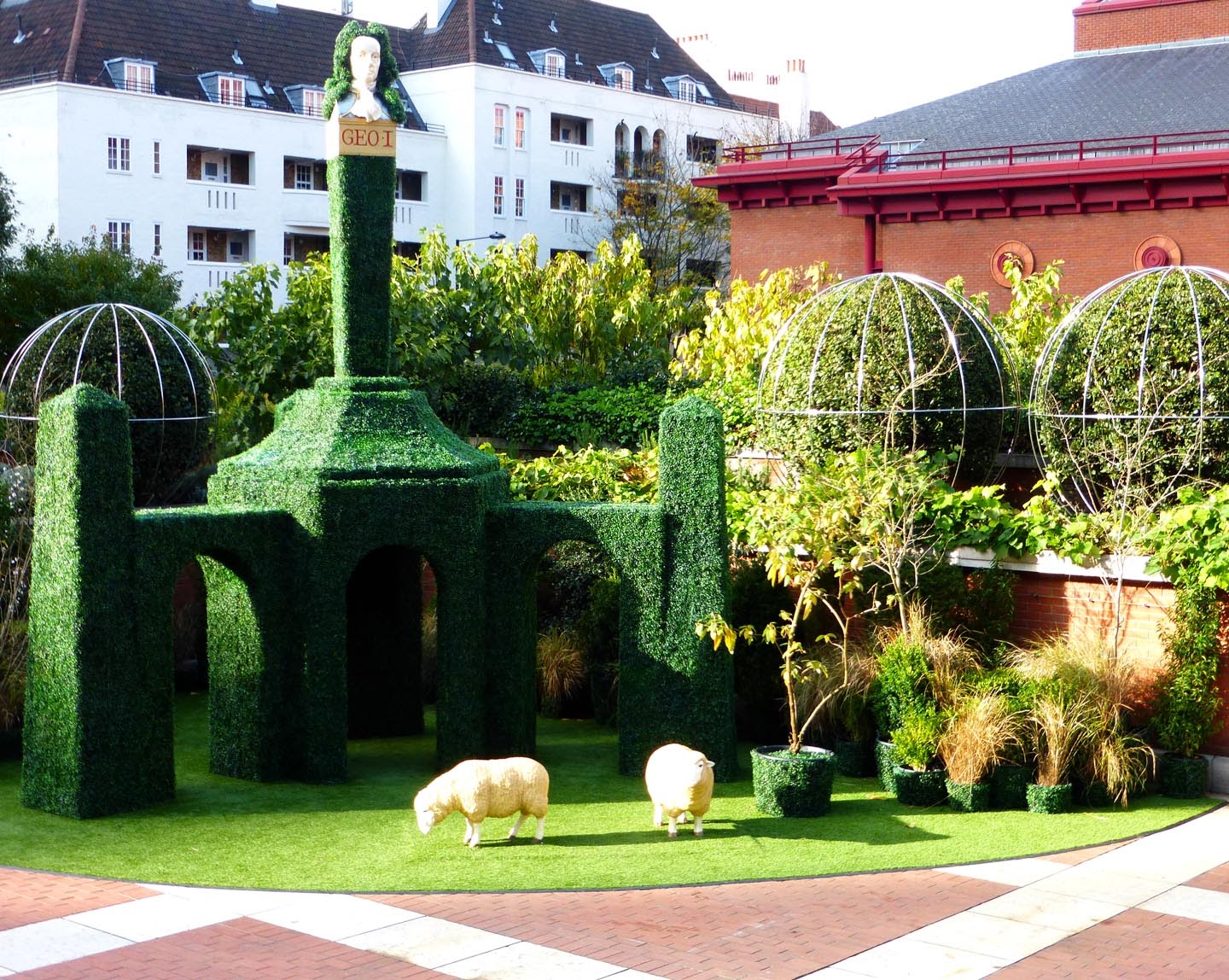
A fascinating glimpse of a society not dissimilar to our own. Unprecedented economic, social and cultural changes in Britain under the Hanoverian kings meant the Georgians enjoyed leisure activities such as shopping for luxuries, reading fashion magazines, gardening, picnics and sightseeing. They loved balls and assemblies, visited new museums and galleries, followed the fortunes of celebrities and went to the pantomime. This exhibition shines a spotlight on the years between 1714 and 1830, with books, paintings, letters and costumes. A bonus is a recreation of a Georgian garden (left) which you can see for free in the Library forecourt. And if you want to discover more about this era, the exhibition guide includes a walking tour that takes in some of London’s finest Georgian museums – all within a short distance of the British Library.
More at http://www.bl.uk/whatson/exhibitions/georgiansrevealed/index.html

Hello, My Name is Paul Smith
Design Museum to March 9 2014. Admission £11.85.

Sir Paul Smith’s career in fashion spans more than 40 years. This exhibition takes you on a journey from the minuscule first shop he opened in Nottingham in 1970.to the global reach of his empire today. On the way, you see a recreation of his Aladdin’s cave of an office in Covent Garden, London, examples of his many design projects (including one of his beloved striped Minis), some of the  paintings and objects which have inspired his work, and a personal selection of clothes from his archive (below). 

A fascinating look at the creative process of this British fashion legend.  Further information: www.designmuseum.org