My Blog List

Monday, 19 September 2016

Walking the Lea Valley (1): An everlasting flame, London’s only lighthouse and the embarkation point for the New World


Who would have thought a walk that began surrounded by the roar of traffic on the A102 and took us past an industrial estate and derelict gas works could contain such gems?
Walking the Lea Valley is the new project for our local walking group. We're doing it bit by bit, and started by heading south from Bromley-By-Bow to find the river's junction with the Thames.

Our first glimpse of the Lea was by the Twelvetrees industrial park, where the Limehouse Cut runs alongside the Lea before branching west to the Limehouse Basin. Not very picturesque - though the grey weather probably didn't help. But a few minutes away was our first surprise – a tranquil memorial garden commemorating those who worked at the adjacent Bromley by Bow gas works and died in the two world wars.
In its centre is a gas flame that never goes out. Two remaining gas holders loom over the garden and there’s an imposing statue of Sir Corbet Woodhall (1841 – 1916), engineer and Governor of the Gas Light and Coke Company.
Along the road is a handsome building that once housed the London Gas Museum. Sadly, this closed some 15 years ago. Its contents are now dispersed - some are stored in Leicester.
The trail took us through another industrial estate to Star Lane DLR station and thence to Canning Town, where we reconnected with the Lea - now Bow Creek. A complete contrast here: wasteland transformed into the new Bow Creek Ecology Park. The tide was out, but as we looped around it, information boards explained how the mud is important, supporting a wide range of creatures.
Wildflowers abound in the park's meadows. Apparently part of these are flooded in September to mimic the flooding of the river floodplain, which no longer happens naturally because of the canalisation of the river.
Back on the road, we walked through Orchard Place, green and rural until the Industrial Revolution, then home to the great shipyards of Perry, Wigram and Green, the Samuda Brothers and the Thames Ironworks. Boys from Orchard Place were employed to crawl into ships’ boilers to scrape them clean, ready for survey. They were called ‘scurfers’. The surrounding area, isolated, poor and prone to flooding, became a slum. Father Lawless, a local priest, wrote of the inhabitants in the 1890s: “Hardly human...incarnate mushrooms. God must have made a mistake in creating them.” By the 1930s all the inhabitants were moved into Poplar, and the village demolished.


Now, however, the area is being transformed, thanks in part to the spillover from Olympic Park development, Crossrail and across the river, the O2 and Emirates Air Line. Hoardings trumpet the new London City Island (above), which will have luxury apartments in glass and steel complexes (dubbed a 'mini-Manhattan') and provide a new home for the Royal Ballet.
  Orchard Place now has a sculpture - a taxi with a tree growing out of it.
Trinity Buoy Wharf, where all the buoys and markers for the Thames were once made and repaired, still has a buoy, but is now the centre of a growing creative community.
A village of recycled shipping containers (above) that serve as artists’ studios, offices and homes. now surrounds the Grade II-listed warehouses (below).
Quirky sculptures abound.
The Royal Drawing School has its Foundation Year Art School there, and a tiny wooden hut beside the lighthouse houses what must be London’s smallest museum, the Faraday Project.

This is devoted to the Victorian scientist, Michael Faraday, who conducted experiments into electric lighting in the lighthouse in 1863. The lighthouse itself has become an arts venue, and looks out on to a restored 1938 lightship, now a recording studio. At the water’s edge, by the Thames Clipper pier, are two installations, Alunatime, London’s first public moon and tide clock, and Floodtide, which makes music determined by the river’s tide.
Finally we reached the point where the River Lea - Bow Creek - meets the Thames.

We stopped for a very welcome lunch at the Bow Creek cafe right by the lightship, then headed around the old East India docks entrance basin. Built between 1803 and 1806, this is all that remains of the once-vast complex. It's now a wildlife refuge, but you can still see the entrances to the import and export docks, overshadowed by new developments.
Our last stop before we reached the East India DLR was outside another new development, Virginia Quay.
Here, a memorial, topped by an astrolabe, marks the site where on December 19, 1606, three small ships laden with supplies and adventurers set sail for Virginia. Against all odds, and suffering great hardship, they established a new colony and laid the foundation for the present United States of America.

It was a fitting end to what turned out to be a fascinating walk through centuries of history. In Chaucer’s time, Bromley-By-Bow, where we started, was known as Stratford-atte-Bowe, the site of a Benedictine nunnery. (In his Canterbury Tales, the author gently mocks the Prioress as speaking French “after the school of Stratford-atte-Bowe, for French of Paris was to her unknown.”)  The 'Bow' was from the shape of a local bridge.
The Limehouse Cut dates back to 1770, and the Gas, Light and Coke Company was formed in 1812. The lighthouse at Trinity Buoy Wharf (above) was built in 1864, and though East India Docks are now mostly filled in, during World War II they played a key role as a location for constructing the floating Mulberry harbours used by the Allies to support the D-Day landings in France. Looking at all the cranes and development going on, I was left wondering what the future will bring to the area.


Monday, 29 August 2016

Egg and chips anyone? Growing Thompson and Morgan’s new grafted plant.


It’s always fun to try something different in the garden. For me, this year it was Thompson and Morgan’s Egg and Chips plant, hand-grafted so it grows aubergines (aka egg plants) from its stem and potatoes from its roots – great for gardeners without the luxury of an allotment or large veg patch. (The two vegetables belong to the same plant family, known as the Solanaceae or nightshade.)  This novelty arrived by post in May, protected by a plastic cylinder, looking very healthy. Planted up on the sunny terrace in a large container (as per the instructions), it soon expanded to fill the space. Delicate mauve flowers began emerging in July, but it wasn’t until August that they began to set.
While Thompson and Morgan claim an average of three or four large aubergines per plant, I now have five aubergines of various sizes hanging there, with another four flowers looking promising. The potato yield could be up to two kg, suitable for boiling, mashing or, of course, chips. The spuds seem to have begun producing their own foliage, so I'm looking forward to seeing what lies beneath when all this yellows and dies down.
http://www.thompson-morgan.com/vegetables/vegetable-plants/all-vegetable-plants/egg-and-chips/t67489TM

Wednesday, 10 August 2016

Anyone interested in crafts?

Paul Martin's Handmade Revolution is on BBC2 this week and next - a celebration of British crafts and crafters. So many inspiring ideas, including an exquisite dress made by felting in episode 1 (shown on Monday 8). One of the judges is Mary Jane Baxter, author of Chic on a Shoestring and The Modern Girl's guide to Hatmaking.
Unfortunately it's on at 6am, but there's always the iplayer.....

 http://bbc.in/2aIvzK9

Thursday, 21 July 2016

Front garden inspiration at RHS Hampton Court Flower Show


.  
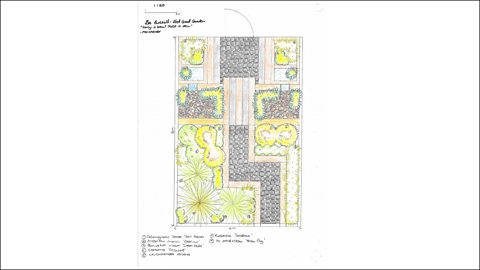
It was great to see young horticultural talent on display at this year’s RHS Hampton Court Flower Show. Step forward Lee Burkhill (above), whose ‘Fancy a brew? Take a Pew’ design for BBC Radio Manchester was among the four winners in the BBC Local Radio Front Garden Design Competition and was turned into reality for the event. A survey by the RHS last year found that three times as many of our front gardens are now paved over compared with ten years ago, while five million have no plants growing in them at all – not even a lonely geranium in a pot. Yet plants and good design can have positive effects on people's health and happiness.
                       
The challenge was to take a small 6m x 4m plot and show what could be achieved (above). Lee's inspiration came from Manchester’s industrial heritage and community spirit. With a cobbled garden path symbolic of the famous Coronation Street cobbles, reclaimed railway sleepers containing raised beds and water reflecting the city’s canals, he included seating and a bench to encourage neighbours to stop and share a cuppa. 

The planting list includes: Calamagrostis stricta ‘Karl Foester’, Nepeta govaniana, Aster radular ‘August sky’, Festuca amethystine, Anstrantia major ‘Snow storm’, Sangisorba tenuifolia, Pennisitum ‘Orientale’, Melica altissima alba, Deschampsia cespitosa ‘Garnet Schist’, Verbena bonariensis, Echinacea ‘Hot Lava’, Echinacea ‘Big Kahuna’, Hellenium flammendes, Echinacea ‘Hot Summer’, Hellenium moerheim ‘Beauty’, Sangisorba officinalis ‘Tanna’, Alchemilla mollis, Juncus effuses, chinacea ‘Tikki Torch’, Myrtus communis.
As well as running his own garden design business, Lee also has a blog which he uses to help and inspire garden newbies. I don't think this is the last we'll be hearing of him.
The three other winners were Simon Judge (BBC Radio Bristol), Jenny Booty, Lizz Dobinson, Nicky Shellis and Tim Walker from the Eden Project Learning (BBC Radio Cornwall) and Sarah H. Morgan (BBC Radio Kent). See  http://www.bbc.co.uk/programmes/articles/57Khp4Hqkldy62bfggtqRL8/bbc-local-radio-and-rhs-design-a-garden-competition

Thursday, 14 July 2016

In search of the source of the Dollis


After a morning that began with brilliant sunshine and ended with thunder and rain, we were finally in sight of our goal – Moat Mount (above), the source of the Dollis stream. Our neighbourhood walking group had been following its course along the Dollis Valley Greenwalk over the summer. This was the last section, and we were keen to see where it emerged from the earth.
The morning’s ramble had started several miles further east, picking up the stream near Dollis Valley Way. We has been lucky spotting birds along the more southern section, but here the wildlife seemed to have gone into hiding, though someone heard a kingfisher. The stream itself at this point is not much bigger than a large ditch, and hidden by trees and undergrowth. However the views of the wide open spaces beside it more than made up for that.
We passed playing fields, meadows and farmland, where until early last century, hay was grown for London horses (below).
The path took us over a couple of stiles – an oddity in London - past the Old Cholmeleian sports ground, with its carefully-mown cricket pitch, and into the Totteridge Fields nature reserve.
This site is managed by the London Wildlife Trust, and can apparently attract thousands of butterflies. The reserve is mostly meadow, surrounded by hedgerows the Trust says are remnants of the once extensive oak/hornbeam coppice woodland.
At this point the rain became really heavy, and we took shelter under a huge oak (above), its ivy-covered trunk probably about five feet across. Nearby was a bee box, placed there to house rescued, trans-located bumblebees.
Some wild dog-roses were tangled amongst the brambles.
Once the rain eased, the walkway took us past farmland, along Hendon Wood Lane, once probably a minor Roman road – Roman coins were found there some years ago – and up to Barnet Gate Wood. This is a remnant of the extensive Middlesex forest, which covered most of the area after the last Ice Age. (Barnet Gate was for a long time called Grendelgate, after Grendel, the monster from the Anglo-Saxon epic poem, Beowulf, and the name suggests the place was of some importance in Saxon times.) From there we headed towards the Moat Mount Nature Reserve and suddenly before us there it was: a clump of dense trees where the springs that feed the Dollis first emerge. But then the rain really set in.

I did spot a trickle of water in some mud but it was still some way from the trees that were to have been our final destination. And as the rain got heavier, we reluctantly decided to abandon the exploration of Moat Mount – once the site of a moated house and then a grand Victorian villa – and seek shelter in a nearby restaurant. So the source of the Dollis for us remains undiscovered - until another day.

PS: Should anyone be wondering where the name Dollis originated, there seem to be several possible explanations. Dollis is thought to be derived from the British dylif (a flood) or the Anglo-Saxon dwllice (erratic) while Dollis Hill may take its name from a former inhabitant called Dolley or Dawley. 

For details of a previous Dollis stream walk, see 

More about the Greenwalk at: 
http://www.wildlondon.org.uk/
https://www.barnet.gov.uk/citizen-home/parks-sport-and-leisure/parks-and-open-spaces/dollis-valley-greenwalk