
Tuesday, 18 February 2014
Thought for the day?

Wednesday, 12 February 2014
Meeting the ancestors
 |
| Dr Nick Ashton with footprint model |
Last May, our understanding of British history
was changed forever by a chance find on a Norfolk beach. Dr
Nick Ashton of the British Museum and some fellow archaeologists were surveying the
foreshore at Happisburgh when they
noticed a storm had washed away sand and uncovered a series of unusual
indentations in the compacted silt. Photographs and further analysis revealed
these to be a cluster of fossilised footprints, made by as many as five people,
adults and children, who had walked across the estuary some 900,000 years
ago.
They’re the oldest footprints found outside
Africa and with stone tools unearthed nearby, show ancient humans arrived in the
UK some 400,000 years earlier than previously thought.

The tallest of the group
was a man, probably about 5ft 7in, who would have belonged to the only human
species found in Europe at that time, a fully upright person called Homo
antecessor – ‘pioneer man’. He would have looked something like this model head. A
display about the footprints – now,
sadly, washed away – opens a fascinating new
exhibition at London’s Natural History Museum, 'Britain: One Million Years of
the Human Story' There's a video about them at
http://www.nhm.ac.uk/visit-us/whats-on/temporary-exhibitions/britain-million-years/happisburgh-film/index.html
The galleries bring you face to face with your distant ancestors. When you reach the mid-point, there are two lifesize models of early men – one Neanderthal (left) the other Homo Sapiens (below). They’re the work of Dutch artists, the Kennis brothers, and you can watch a video of their creation at http://www.youtube.com/watch?v=znUvFxsrMOs )
+Trustees+of+NHM.jpg)
+Trustees+of+NHM.JPG) It's a dramatic exhibition, with modern copies
of flint tools that you can touch, and videos putting the discoveries in
context. Animal cries echo through the galleries, adding to the
atmosphere. Other finds that throw light on this distant past include skeletons from Gough’s
Cave in Somerset that reveal evidence of cannibalism almost 15,000 years ago (left) and a hippo
tooth from Trafalgar Square in London (imagine hippos swimming in the Thames!) From Clacton in Essex comes the oldest wooden spear point ever
found (below). Fashioned 400,000 years ago from yew wood, it would have
been the weapon of choice for a brave hunter trying to stab an animal at close
quarters.
It's a dramatic exhibition, with modern copies
of flint tools that you can touch, and videos putting the discoveries in
context. Animal cries echo through the galleries, adding to the
atmosphere. Other finds that throw light on this distant past include skeletons from Gough’s
Cave in Somerset that reveal evidence of cannibalism almost 15,000 years ago (left) and a hippo
tooth from Trafalgar Square in London (imagine hippos swimming in the Thames!) From Clacton in Essex comes the oldest wooden spear point ever
found (below). Fashioned 400,000 years ago from yew wood, it would have
been the weapon of choice for a brave hunter trying to stab an animal at close
quarters. +Trustees+of+the+NHM.jpg)
One thing becomes very clear from the
displays: climate change is nothing new. These early Britons had to cope with
multiple Ice Ages and appear to have disappeared at least nine times over the
last million years, being replaced as the weather warmed up again by further
groups crossing the land bridge that linked Europe to Britain.
The exhibition is the result of a 12-year
project funded by the Leverhulme Trust, involving 50 archaeologists,
palaeontologists and Earth scientists from more than 20 research institutions
and universities, and directed by Professor Chris Stringer of the Natural
History Museum.
An intriguing footnote is provided by six
personalities – among them Professor Alice Roberts - who have had their DNA
analysed for traces of Neanderthal ancestry. The results are surprising (her
genes are 2.7 per cent Neanderthal) and may prompt an even closer look at some
of the exhibits. (see the video at
http://www.nhm.ac.uk/visit-us/whats-on/temporary-exhibitions/britain-million-years/tracing-genetic-ancestry-film/index.html )
http://www.nhm.ac.uk/visit-us/whats-on/temporary-exhibitions/britain-million-years/tracing-genetic-ancestry-film/index.html )
Britain: One Million Years of
the Human Story, Natural History Museum,
13 February to 28 September 2014. See http://www.nhm.ac.uk/
Monday, 16 December 2013
Spring in December

Apparently the mild weather in London has tricked nature into
thinking spring is here already. That might explain why this Duchess of
Edinburgh clematis, planted as a tiny seedling in the late summer, began
flowering a few weeks ago. The heavy rain and strong winds have left it rather bedraggled, but still the blooms hang on. A Choisya Ternata Sundance has also surprised me by
breaking out in fragrant white flowers.
 At the same time, there’s been an influx of early-morning
visitors to the garden. Jays, tits, wood pigeons, blackbirds, a robin and two
squirrels were spotted chasing around, competing for the seed spilt
from the bird feeder. But the surprise sighting was this green woodpecker,
which spent about 20 minutes determinedly digging away in the lawn. This was
only the second time we’ve seen one – the last time was several years ago, in
the oak tree.
At the same time, there’s been an influx of early-morning
visitors to the garden. Jays, tits, wood pigeons, blackbirds, a robin and two
squirrels were spotted chasing around, competing for the seed spilt
from the bird feeder. But the surprise sighting was this green woodpecker,
which spent about 20 minutes determinedly digging away in the lawn. This was
only the second time we’ve seen one – the last time was several years ago, in
the oak tree.
According to the Met office, the mild weather is set to
continue over the coming month.
Friday, 15 November 2013
My top London exhibitions for Autumn-Winter 2013
If you're in the market for some great exhibitions this winter, London is the place to be. Here’s a look at some of
my favourites.
The
Cheapside Hoard: London’s
lost jewels
Museum of London to April 27 2014. Admission £10


A dramatically lit
exhibition of late 16th and early 17th century jewels and gemstones, found hidden under a floor in nearby Cheapside in 1912 and displayed together for the first time in over a century. Lots of bling, with contemporary portraits showing how they would have been worn. Left is a cameo of Elizabeth 1, c. Museum of London. No bags allowed in – you need a £1 coin for a locker before going through security.
(See
my previous post http://greenjottings.blogspot.co.uk/2013/10/buried-treasure-cheapside-hoard.html for a more detailed look.)
Beyond El Dorado: Power and Gold in ancient Colombia
British Museum, to March 23, 2014. Admission £10
 Another
blockbuster, which looks beyond the legend of El Dorado, sometimes imagined as a lost city
of gold, sometimes as a man covered in powdered gold. It shines a spotlight on
the varied cultures which existed across the region before the arrival of the
Spanish in the 16th century. It makes the point that gold was not
valued as a currency, but had great symbolic meaning, and was seen as giving divine
power to the elite. There are more than 300 stunning objects, many reflecting
the natural world, such as golden masks of jaguars, bats and frogs. Others use
textiles, feathers, stones and ceramics. Some have come from the Museo del Oro in Bogota and are being displayed in the UK for the first time, while others are from the British Museum’s collection. (Some were featured
in the Gold of El Dorado exhibition at the Royal Academy in London in 1978.)
Another
blockbuster, which looks beyond the legend of El Dorado, sometimes imagined as a lost city
of gold, sometimes as a man covered in powdered gold. It shines a spotlight on
the varied cultures which existed across the region before the arrival of the
Spanish in the 16th century. It makes the point that gold was not
valued as a currency, but had great symbolic meaning, and was seen as giving divine
power to the elite. There are more than 300 stunning objects, many reflecting
the natural world, such as golden masks of jaguars, bats and frogs. Others use
textiles, feathers, stones and ceramics. Some have come from the Museo del Oro in Bogota and are being displayed in the UK for the first time, while others are from the British Museum’s collection. (Some were featured
in the Gold of El Dorado exhibition at the Royal Academy in London in 1978.)
More
details at www.britishmuseum.org
Paul Klee:
Making Visible
Tate
Modern, to March 9 2014. Admission £15

There are
plenty of the bold blocks of colour that characterise many of Klee’s paintings,
but as this exhibition shows, he was constantly experimenting and trying new
forms of expression, both representational and abstract. There are
delicate line drawings, watercolours, oils, even some sorties into pointillism.
They’re hung in the order in which they were created, thanks to his meticulous
recording and cataloguing, so you can see how he developed different
themes and moved from one idea to another. Be aware that it’s a large
exhibition – 17 rooms, covering his whole career.
More at www.tate.org.uk
Georgians
Revealed: Life, Style and the Making of Modern Britain.
British
Library, to March 14 2014. Admission £9, under 18s free.
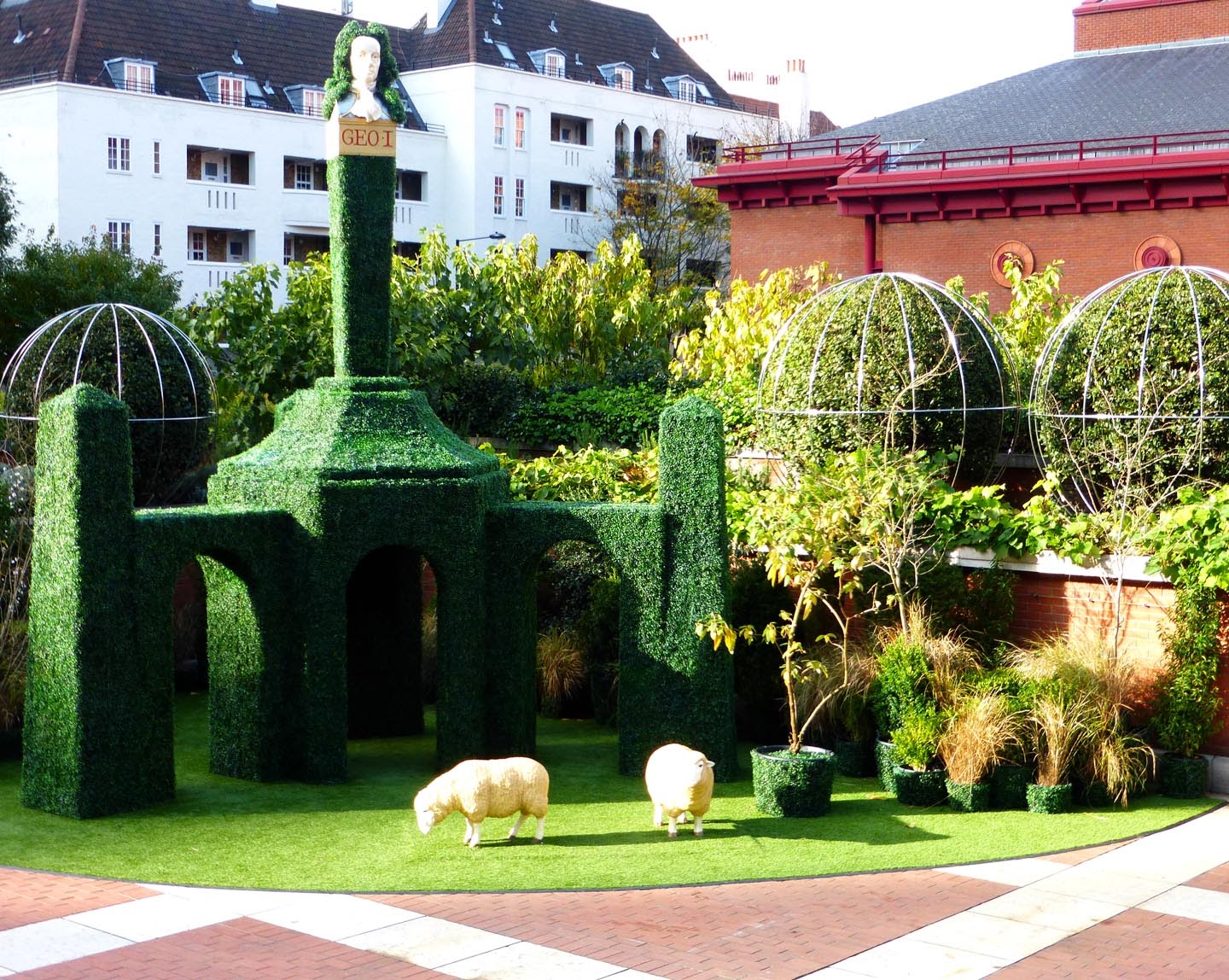 A
fascinating glimpse of a society not dissimilar to our own. Unprecedented economic,
social and cultural changes in Britain
under the Hanoverian kings meant the Georgians enjoyed leisure activities such
as shopping for luxuries, reading fashion magazines, gardening, picnics and
sightseeing. They loved balls and assemblies, visited new museums and
galleries, followed the fortunes of celebrities and went to the pantomime. This exhibition shines a spotlight on the
years between 1714 and 1830, with books, paintings, letters and costumes. A bonus
is a recreation of a Georgian garden (left) which you can see for free in the Library
forecourt. And if you want to discover more about this era, the exhibition guide
includes a walking tour that takes in some of London’s finest Georgian museums – all within
a short distance of the British Library.
A
fascinating glimpse of a society not dissimilar to our own. Unprecedented economic,
social and cultural changes in Britain
under the Hanoverian kings meant the Georgians enjoyed leisure activities such
as shopping for luxuries, reading fashion magazines, gardening, picnics and
sightseeing. They loved balls and assemblies, visited new museums and
galleries, followed the fortunes of celebrities and went to the pantomime. This exhibition shines a spotlight on the
years between 1714 and 1830, with books, paintings, letters and costumes. A bonus
is a recreation of a Georgian garden (left) which you can see for free in the Library
forecourt. And if you want to discover more about this era, the exhibition guide
includes a walking tour that takes in some of London’s finest Georgian museums – all within
a short distance of the British Library.
More at http://www.bl.uk/whatson/exhibitions/georgiansrevealed/index.html


Hello, My
Name is Paul Smith
Design Museum to March 9 2014. Admission £11.85.

Sir Paul
Smith’s career in fashion spans more than 40 years. This exhibition takes you
on a journey from the minuscule first shop he opened in Nottingham
in 1970.to the global reach of his empire today. On the way, you see a recreation of his Aladdin’s
cave of an office in Covent Garden, London, examples of his many design projects
(including one of his beloved striped Minis), some of the paintings and objects which have inspired his
work, and a personal selection of clothes from his archive (below).

A fascinating look at the creative process of
this British fashion legend. Further information: www.designmuseum.org
Saturday, 19 October 2013
Buried treasure – the Cheapside Hoard

In June 1912, some labourers excavating the cellar of an old building in Cheapside in the City of London, struck gold – literally. Under the floor they discovered a tangle of 16th and 17th century jewels and gemstones including delicate finger rings, cascading necklaces, Byzantine cameos, jewelled scent bottles, and a watch set in an enormous Colombian emerald (below).

They’d been there for some 300 years, probably the stock-in-trade of one of the jewellers who had premises on Cheapside.. Who was he and why were they hidden? It's still a mystery. But conservationists preparing them for exhibition at the Museum of London have found a clue as to when they were buried. One of the gemstones (left) is engraved with the heraldic badge of the first and only Viscount Stafford. He received his coat of arms in 1640, while the blackened layer above the hoard dates from the Great Fire of London in 1666. Those 26 years were a time of great upheaval, with civil war and plague taking the lives of many and forcing others to flee their homes. Perhaps the jewels were hidden for safekeeping and the owner never returned. The museum is hoping someone may know more – perhaps a descendant of one of the labourers, or even a person with a family story of lost jewels – and they’ll come forward to shed more light on the discovery.
 There are almost 500 jewels in the hoard and this exhibition is the first time they've been displayed together since they were found - some have been housed at the British Museum. The display is dramatic, with dark walls and spotlights making the pieces gleam and sparkle. Magnifying glasses are provided for a closer look at the delicate workmanship such as that in this emerald, diamond and enamel salamander (left) and gold enamelled chain (below).
All photos © Museum of London
The Cheapside Hoard – London’s Lost Jewels is at the Museum of London until 27 April 2014.
http://www.museumoflondon.org.uk/london-wall/whats-on/exhibitions-displays/cheapside-hoard-londons-lost-jewels/
Wednesday, 11 September 2013
A last burst of summer at Hinton Ampner


This tortoiseshell butterfly was making the most of the sunshine at Hinton Ampner last week. It was one of hundreds, flitting from dahlias to buddleias and back again.
The property, now owned by the National Trust, has 12 acres of gardens, characterised by a series of linked ‘rooms’. There's a lily pond that Monet would have loved, a Long Walk, rose borders inspired by Sissinghurst and plenty of topiary. The result has been described as one of the great gardens of the 20th century.

This, and the house, reflect the tastes of Ralph Dutton, 8th and last Lord Sherborne. He inherited the property in 1935 and rebuilt it after a devastating fire in 1960 which started in the library. He remodelled the rooms and filled them with his collections of fine Georgian furniture and 18th century paintings. Of the garden, he wrote: "I have learned during the past years what above all I want from a garden: this is tranquillity".
 The property has magnificent views across the rolling Hampshire countryside. The Battle of Cheriton, a major encounter of the Civil War that ended in a Royalist defeat, took place nearby in 1644. Local inhabitants are said to have looked across at the battle from Hinton Ampner’s grounds.
 Petersfield Rd Hinton Ampner, Bramdean, Hampshire SO24 0LA
Wednesday, 21 August 2013
A Paris garden in the sky

Green walkways: a brilliant way to link and rejuvenate inner-city areas. In 2009, New York opened the High Line park, using a 1.5-mile stretch of abandoned elevated railway, while Chicago has plans for a nearly three mile-long Bloomingdale Trail, again along a disused rail line. In London, two architecture firms have won a competition to design a landscaped walkway just south of the River Thames, joining galleries, public works of art and an open-air auditorium.There’s also a proposal by Thomas Heatherwick, the designer behind the stunning Olympic cauldron, for a floating garden to bridge the Thames from Covent Garden to the South Bank.

But the project that started it all is in Paris - the Promenade Plantée, an aerial nature walk opened late last century (above and left). It snakes through the 12e arrondissment, using a derelict 19th c railway viaduct that once took passengers from Bastille, in the city centre, out to the leafy Bois de Vincennes. When the line was closed in 1969, the structure became a decaying eyesore. But instead of pulling it down, the authorities transformed it into a garden. The arches below became the Viaduc des Arts, with shops showcasing crafts such as cabinet making, tapestry restoration and interior design.

Subscribe to:
Posts (Atom)